Inspiration
On June 10, 2026, two students from UC Berkeley were swept into the ocean by dangerous surf and rising tides along the Santa Cruz County coast near Panther/Bonny Doon beach, and died. Last year a classmate from my computational models class at UCSC drowned while cliff jumping. I also know surfers who have come close to drowning.
Every one of these happened at a spot with no lifeguard and nobody watching, and by the time someone on shore noticed and called for help, the window to save them was already closing. Santa Cruz has a short list of spots where this keeps happening. I built Cruz Watch because those spots should have something watching them.
What It Does
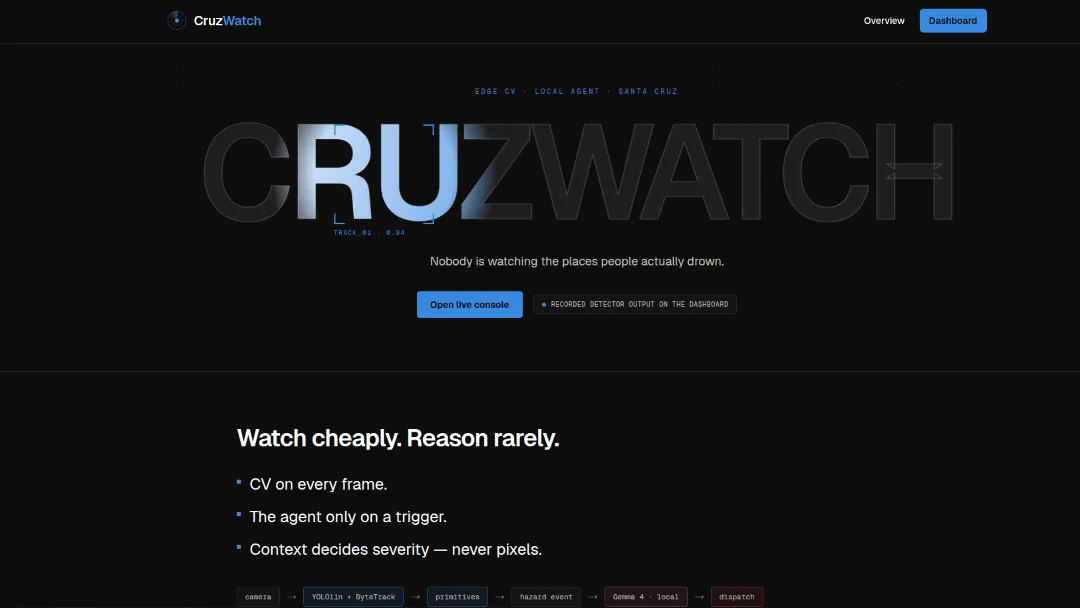
- Watches camera feeds at high-risk Santa Cruz spots, both coastal and downtown.
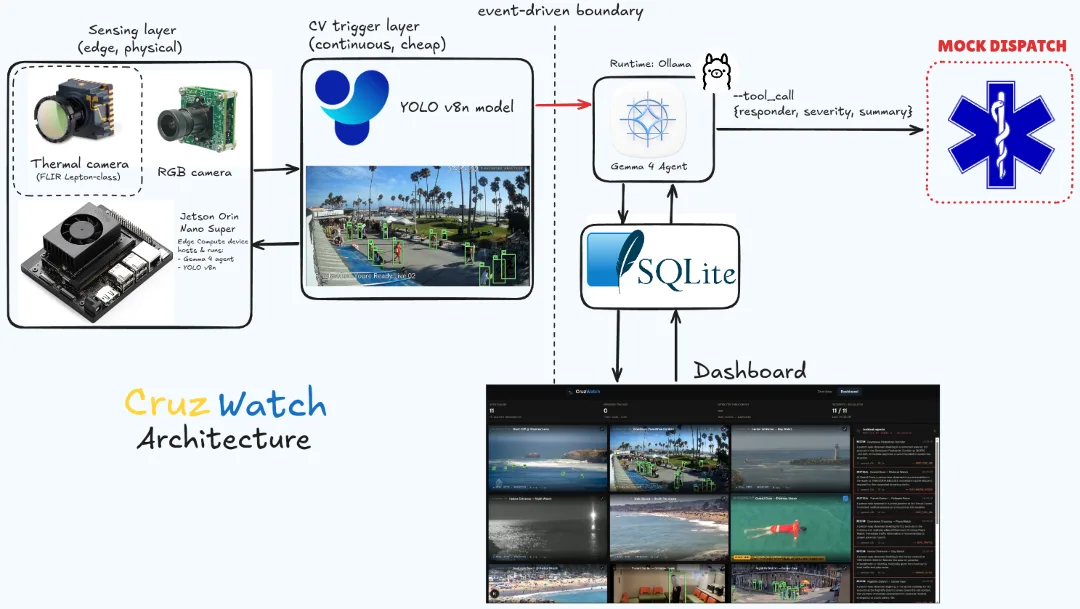
- A lightweight YOLO detector runs on every frame and fires triggers: a person dwelling in a danger zone, a person going horizontal in water or on the ground, and motion anomalies.
- On a trigger, Gemma 4 runs locally on device and receives the structured event plus that site's context — never raw video.
- Gemma decides severity, decides whether to escalate, writes the dispatch report, and calls the (simulated) emergency dispatch endpoint.
- The same trigger means different things at different sites, and Gemma
responds differently: a wader at Seabright got
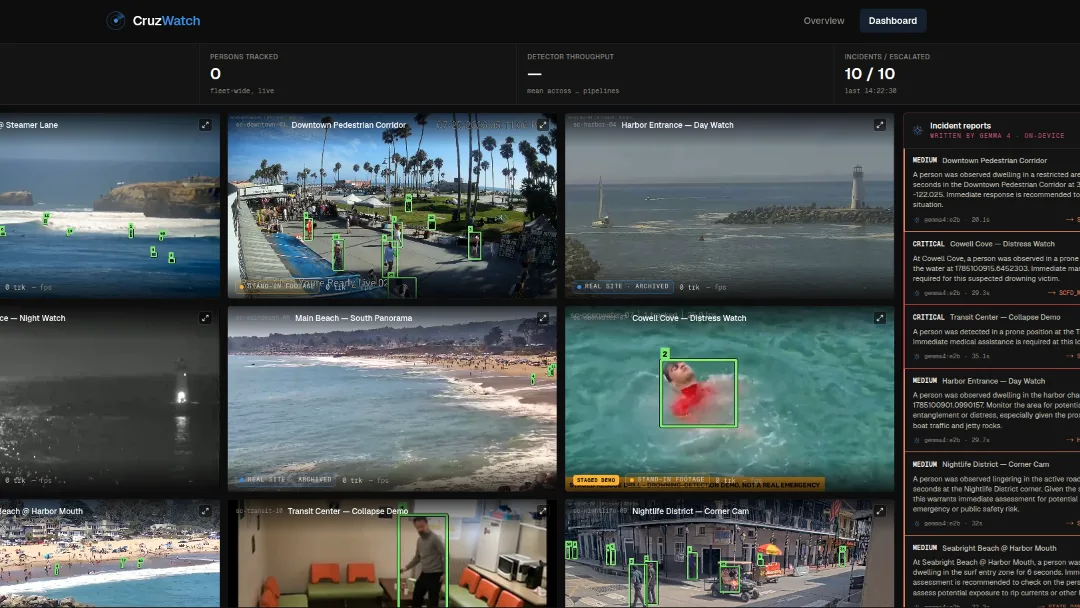
LOWand no escalation, while a face-down floater gotCRITICALand an immediate marine rescue dispatch. - A live dashboard shows a video wall of 10 cams, a sidebar of Gemma-written incident reports, and per-camera detail with the agent's streamed reasoning.
The dashboard, the beach cam detail, and the urban cam detail:
How I Built It
- YOLO11n + ByteTrack in a Python/FastAPI pipeline, with three reusable trigger primitives. Each site is just a JSON config with zones, thresholds, and context for the agent.
- Gemma 4 (
gemma4:e2bthrough Ollama) on my laptop GPU, streaming JSON-constrained output, with a hard timeout and a template fallback so a stall can never hang the pipeline. - Footage from real Santa Cruz cameras: the Steamer Lane surf cam archive, the WebCOOS Walton Lighthouse and Wharf cameras, and the harbor webcam recorded live.
- Drowning and collapse demos use staged footage only: a lifeguard training drill and a research fall dataset, labeled as staged on every frame.
- A Next.js dashboard on Vercel. Detector output is precomputed and stored, and every panel carries a provenance badge saying what is real and what is simulated.
Challenges I Ran Into
- My 15GB laptop froze twice running the detector and the LLM together, so I serialized all GPU work and moved to a precompute architecture.
- The motion anomaly trigger fired 98 times in 180 seconds on surf footage, because every wave ride is a speed spike. I disarmed it and documented why.
- Cameras fought back: auth-walled streams I could only capture by polling a snapshot endpoint once per second, and PTZ cams that switch views and silently break zone polygons.
- Finding ethical distress footage was hard: no real victims, no minors, staged drills only.
- When I told Gemma a feed was a staged drill it correctly refused to escalate. That taught me the disclosure belongs in the UI, and the agent brief is policy.
What I Learned
- Cheap CV on every frame, plus an LLM only on triggers, is what makes agentic AI realistic on edge hardware.
- Context does the real work: identical detector events produce different severities and different responders purely from the site brief.
- Honesty is a feature. Labeling what is real, archived, staged, and simulated made the whole project more credible, not less.
- An agent's prompt is not a description, it is policy.
What's Next
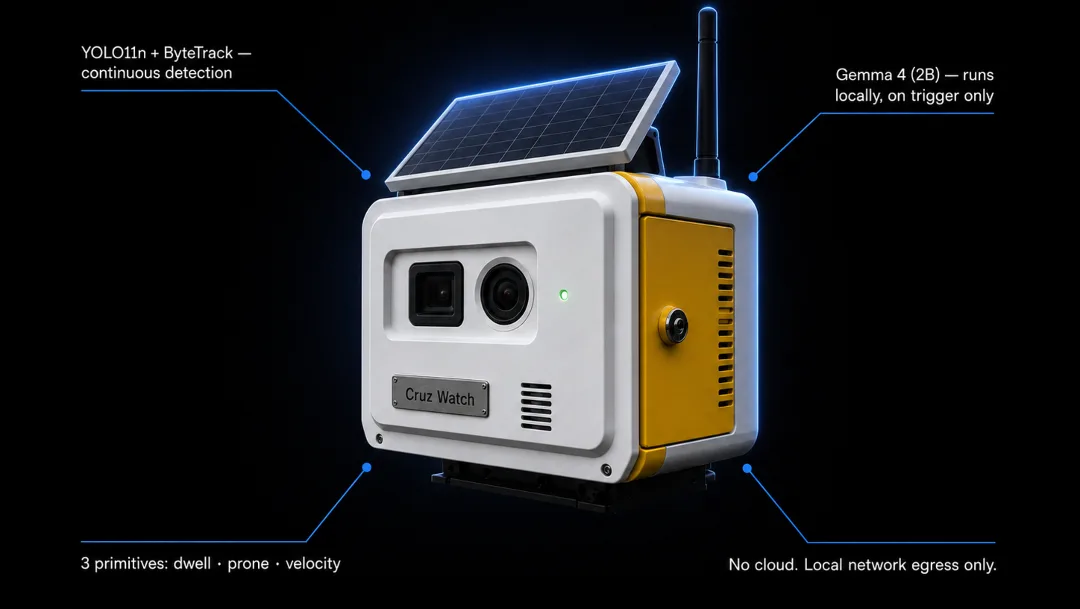
- The real edge unit: Raspberry Pi / Jetson Orin, RGB + thermal camera, solar power — roughly $500 to $800 per site for about 16 target locations.
- Partnerships for live access to the cameras I used as archives.
- Real open-water distress detection research, multilingual alerts, and a pilot with the county.
The proof-of-concept edge unit — what runs on the device, and the parts it is built from:
Built With
Gemma 4, Ollama, Python, FastAPI, YOLO11, ByteTrack, OpenCV, PyTorch, Next.js, TypeScript, Tailwind, FFmpeg, and Vercel.